Country payment guides
China QR payments for foreigners: Alipay, WeChat Pay, and cash
Plan China payments with Alipay, WeChat Pay, UnionPay QR, RMB cash, foreign-card checks, and ADAPAY QR readiness.









Summarize content with
Open this guide in your preferred assistant and keep the payment decisions close.
 ChatGPT
 Perplexity
 Grok
Grok Gemini
What this guide solves
China is one of the easiest places in the world to pay if your phone is set up like a local's. It can also be one of the most awkward places to pay if you arrive with only cash and foreign cards.
This guide explains the China QR payment layer, why Alipay and WeChat Pay matter so much, where foreigners get blocked, and how ADAPAY users should prepare without assuming anything is guaranteed.
Quick answer
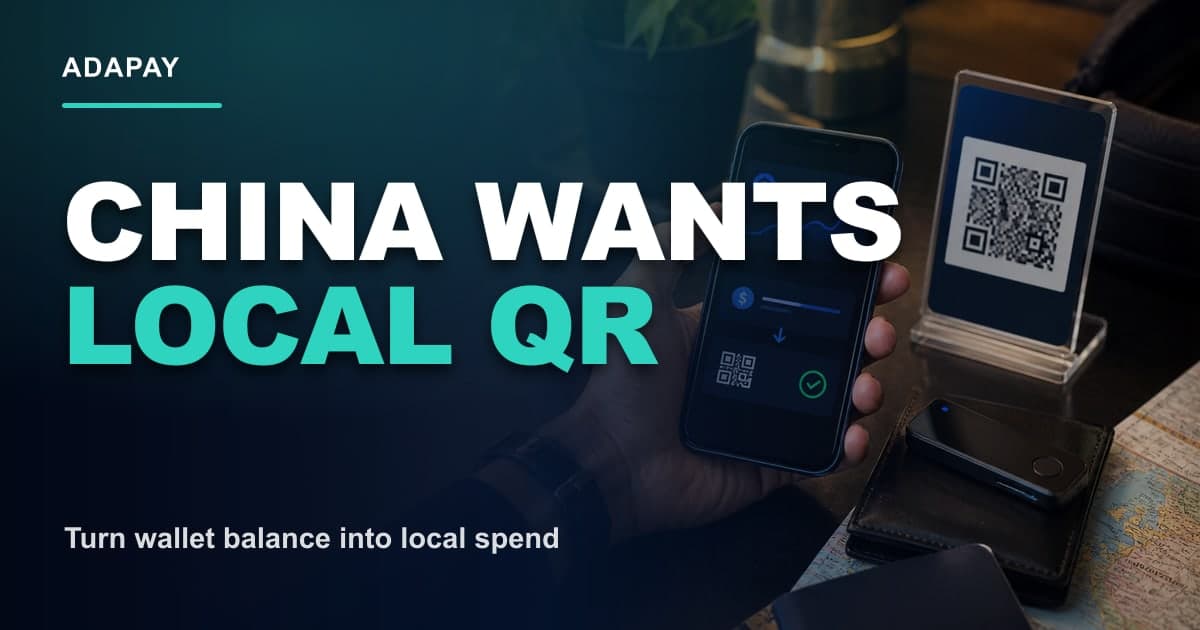
In mainland China, daily payments are built around QR. Alipay and WeChat Pay dominate mobile payments, UnionPay QR is part of the broader rail, and cash is increasingly a backup even though RMB remains legal tender. Foreign cards can work in some channels, but visitors should prepare QR access before relying on taxis, kiosks, small restaurants, markets, transit, or convenience stores.
China skipped the card habit
China did not build daily life around credit-card swiping the way many Western markets did. Much of the country moved from cash to phone-based QR payments, and that jump shaped merchant behavior.
A vendor does not need a full card terminal to accept a QR payment. A printed code, a phone, and a local wallet relationship can be enough. That is why QR shows up at kiosks, food stalls, taxis, restaurants, parking points, convenience stores, and small neighborhood merchants.
For locals, this feels normal. For visitors, it can feel like the whole country is asking for a payment method you do not yet have.
Alipay, WeChat Pay, and unified QR
Alipay and WeChat Pay, also known as Weixin Pay inside China, account for the overwhelming majority of Chinese mobile payments. QR codes are the everyday interface for many of those payments.
The older challenge was fragmentation. A merchant might have one code for one network and another for a different app. Recent unified QR efforts involving UnionPay, Alipay, and WeChat Pay have pushed the market toward simpler cross-network acceptance. The direction is clear: one code should increasingly behave like an entry point into the local payment system, not a walled app-only sticker.
That matters because once one QR can serve more users, merchants have even less reason to keep card or cash routines at the center of the checkout.
Why tourists still hit a wall
Foreign travelers can sometimes link overseas Visa or Mastercard cards to Alipay or WeChat Pay. That is worth trying before travel, but do not treat it as guaranteed.
Setup can run into passport review, card verification, issuer declines, compliance checks, sanctions rules, phone-number friction, or additional review that takes longer than expected. Some users finish in minutes. Others spend a day or more stuck at verification.
The failure is especially painful because the local payment layer works beautifully for people who already have access. The gap is not merchant adoption. The gap is foreign eligibility and verification.
Cash and cards still have a role
Carry physical RMB. Authorities have repeatedly reminded merchants that RMB cash is legal tender, and rules against refusing cash have tightened. In practice, cash is still useful when your phone dies, a rural merchant is offline, a verification flow breaks, or a payment app is unavailable.
But cash should not be your only plan. Small merchants may not keep much change, especially for large notes. A kiosk that technically accepts cash may still move much faster with QR.
Cards have a lane too. Hotels, airports, luxury shops, international chains, and some major transport or booking channels may accept them. Street-level daily spending is where cards become less reliable.
ADAPAY payment planning for China
If ADAPAY offers a China QR route in your app, set it up before you need a purchase to work. Confirm the country, rail, limits, fees, funding method, and identity requirements while you are still on stable internet.
Use this checklist:
- Update ADAPAY before travel.
- Confirm whether China QR support is currently available to your account.
- Keep RMB cash in smaller notes for backup.
- Test a low-value payment before depending on QR for transport or dinner.
- Keep a foreign card for hotels and formal merchants.
- Check the merchant name and amount before confirming any scan.
- Keep your phone charged; in China, payment access often depends on it.
What this means for crypto-funded travelers
Holding stablecoins or another wallet balance is not the same as being able to pay a noodle shop, taxi driver, convenience store, or kiosk. The merchant expects a local payment confirmation, usually through a QR flow they already know.
ADAPAY's job is to reduce that gap when a supported route is available. The merchant should not need to understand your funding method. They should see the local payment arrive in the format they trust.
Final take
China's payment culture is not merely digital-friendly. It is phone-first. Alipay, WeChat Pay, and QR codes have become the everyday payment surface, while cash and foreign cards sit in narrower roles.
For ADAPAY users, the right China plan is clear: confirm QR availability before travel, keep RMB cash as a backup, keep a card for formal merchants, and never wait until a cashier points at a code to discover whether your setup works.
Informational content only
This resource is general information, not financial, legal, tax, or investment advice. Local payment access, coverage, fees, and eligibility can change; verify terms with the relevant provider before relying on any route. ADAPAY's public financial service is not live.
Sources
These public references provide context for this guide and may be updated by the relevant organizations.