QR payment guides
QR code crypto payments in Vietnam, the Philippines, and Thailand
Compare crypto-funded QR payments across VietQR, QR Ph, GCash, Maya, PromptPay, cash, cards, and ADAPAY in Vietnam, the Philippines, and Thailand.







Summarize content with
Open this guide in your preferred assistant and keep the payment decisions close.
 ChatGPT
 Perplexity
 Grok
Grok Gemini
What this guide solves
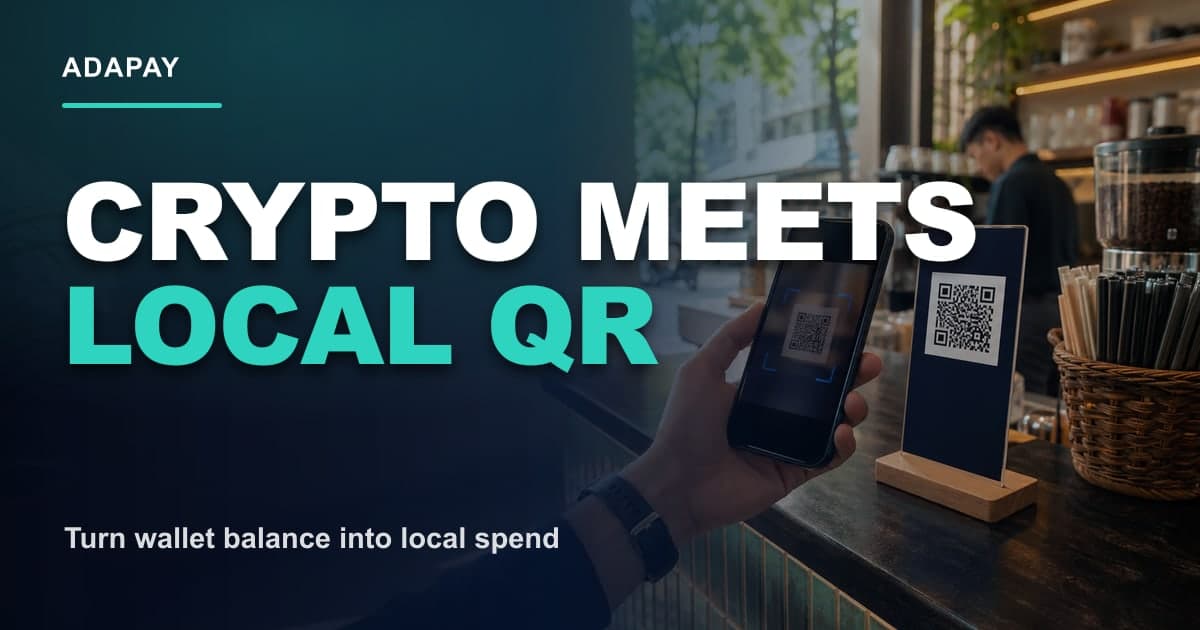
Crypto is liquid online. Local QR payments are liquid on the street. The hard part is connecting those two worlds when a merchant in Ho Chi Minh City, Manila, or Bangkok wants a local payment, not an explanation of networks, wallets, slippage, or exchange accounts.
This ADAPAY guide compares how crypto-funded QR spending works in Vietnam, the Philippines, and Thailand. The common pattern is simple: use stable assets for budget control, convert only what you need, and settle through the local QR behavior the merchant already trusts.
Quick answer
In daily life, most merchants do not want crypto. They want Vietnamese dong, Philippine pesos, or Thai baht through their local QR, wallet, or bank app. That is why the best crypto payment setup is not a direct wallet-to-merchant fantasy. It is a bridge from crypto balance into a local QR payment.
For most travelers and expats, the stack looks like this:
- Stablecoins for holding short-term spending funds.
- ADAPAY as the local QR payment layer where available.
- Cash for markets, rural trips, outages, and tiny purchases.
- Card for hotels, flights, and larger international merchants.
- Receipts and screenshots for rent, clinics, and bigger transfers.
Why stablecoins fit daily spending
Volatile coins are poor tools for a street-level bill. A lunch, ride, clinic visit, or landlord transfer should not change meaningfully because a chart moved while you were waiting at checkout. Stablecoins are easier to budget because they are usually pegged to a fiat currency, often the U.S. dollar.
That does not make them risk-free. Network fees, withdrawal fees, exchange spreads, local conversion, account limits, and compliance checks still matter. The point is practical: stablecoins are easier than volatile assets when the goal is to fund everyday spending instead of speculate.
Vietnam: VietQR and bank transfer behavior
Vietnam is extremely QR-friendly in cities. You will see bank QR codes and wallet QR codes in cafes, street food shops, clinics, apartments, salons, and small retailers. The merchant may expect a direct bank transfer, a wallet payment, or a QR generated from their point-of-sale app.
The challenge for foreigners is access. Many local wallets and bank apps expect local identity, a local phone number, or a Vietnamese bank account. Foreign cards can work in bigger chains but are not the natural method for small merchants. Cash still matters, especially outside major urban neighborhoods.
For crypto holders, the practical ADAPAY workflow is:
- Keep the daily spending portion separate from long-term holdings.
- Fund the local payment route before a busy checkout moment.
- Use QR for cafes, services, local shops, and repeat payments.
- Keep 200,000 to 500,000 VND in cash for stalls, parking, tips, and wet markets.
- Save screenshots for rent-style transfers and high-value payments.
Philippines: QR Ph, wallets, and remittance habits
The Philippines has a deep wallet and remittance culture. GCash and Maya are widely recognized, QR Ph supports interoperable QR acceptance, and many people use digital wallets for bills, transfers, food, transport, and small merchants. At the same time, cash is still essential in many neighborhoods, islands, public transport contexts, and small family-run businesses.
Tourists can run into onboarding friction when wallets ask for local identity, local phone support, or account verification. That makes a QR-ready bridge useful, especially for travelers whose money starts as stablecoins or sits outside the Philippine banking system.
The practical stack:
- Use QR where the merchant is wallet-ready.
- Keep cash for tricycles, markets, ferries, tips, and small eateries.
- Do not assume every GCash or Maya use case is available to every foreign visitor.
- Track conversion costs on remittances, card use, and crypto cash-outs.
- Keep a fallback for islands or weak-data areas.
Thailand: PromptPay and Thai bank QR
Thailand is one of the most QR-shaped travel markets in the region. PromptPay and Thai bank QR payments are common at food courts, coffee shops, markets, clinics, service counters, condos, and local vendors. For tourists, the issue is not merchant acceptance. It is getting access to a payment route that can speak to the local rail.
Opening a Thai bank account can be difficult for short stays and inconsistent for long-stay foreigners. Cards work at larger merchants, but small vendors may prefer QR or cash. ATM fees can add up quickly.
For crypto-funded users:
- Keep a Thai baht cash reserve for tiny vendors and transport.
- Use cards where they are natural, especially hotels and malls.
- Prepare a QR route for PromptPay-style moments.
- Avoid using a fresh P2P trade as the default answer to every local payment.
- Keep receipts for rent, clinics, coworking, and deposits.
What a crypto QR flow should check
Before using any crypto-funded payment flow for daily life, check the full route:
| Step | Question to answer |
|---|---|
| Funding | Which asset, network, fee, and confirmation time are involved? |
| Conversion | What rate and spread apply before local settlement? |
| Limit | Is there a daily, per-payment, or account limit? |
| Merchant | Does the merchant accept the exact local QR route available to you? |
| Receipt | Will you have a payment confirmation you can show or save? |
| Backup | What happens if data, app access, or the merchant QR fails? |
The cheapest-looking route can become expensive if it fails under time pressure. Test small before relying on it for rent, medical bills, or travel bookings.
ADAPAY versus P2P cash-out
P2P has a place, but it is a poor checkout habit. It requires finding a counterparty, agreeing on rate and method, waiting for settlement, and sometimes explaining the delay to a merchant. It can work for a monthly cash refill; it is clumsy when a cafe, driver, clinic, or landlord is waiting.
ADAPAY is meant for the more ordinary moment: your funds are ready, the merchant shows a QR code, and you want the payment to resolve like a local transaction. That is the practical difference between having crypto and being able to spend from it.
Final take
Vietnam, the Philippines, and Thailand are all moving toward QR-first daily payments, but none of them is a single universal crypto checkout layer. The merchant side remains local. The user side can be crypto-funded.
ADAPAY fits the middle: stablecoin-aware users on one side, local QR expectations on the other. For travelers and expats, that bridge matters more than a slogan about crypto adoption. It is what makes rent, food, transport, clinics, and everyday life easier to pay for.
Informational content only
This resource is general information, not financial, legal, tax, or investment advice. Local payment access, coverage, fees, and eligibility can change; verify terms with the relevant provider before relying on any route. ADAPAY's public financial service is not live.
Sources
These public references provide context for this guide and may be updated by the relevant organizations.