QR payment guides
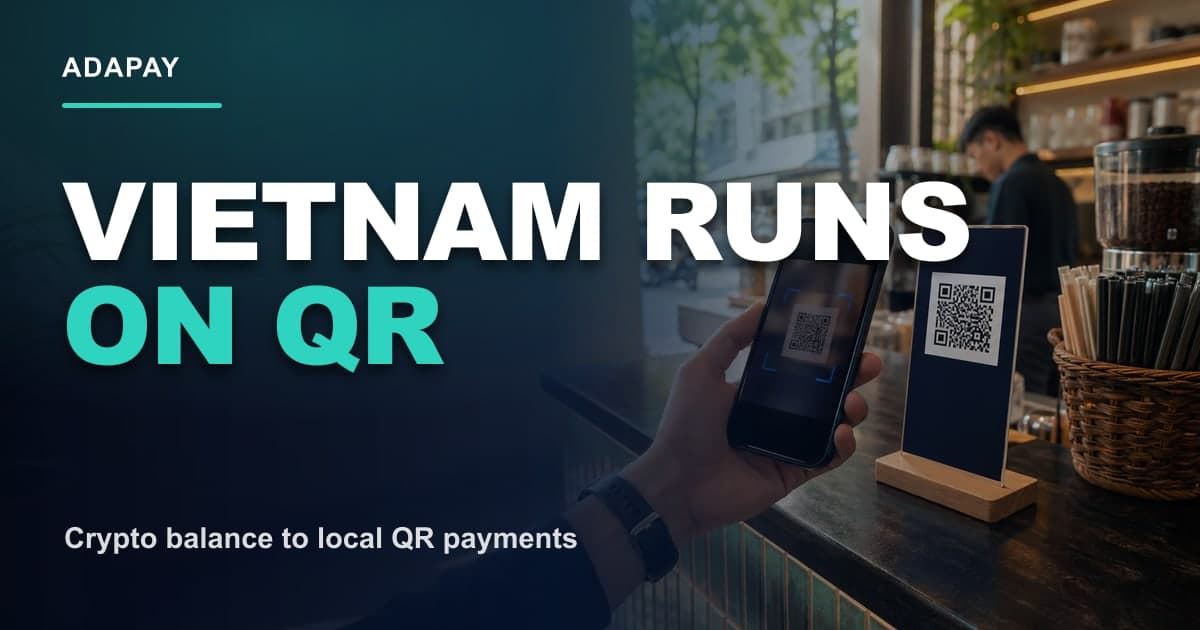
Why QR codes took over Vietnam
Understand VietQR, NAPAS 247, MoMo, ZaloPay, cash limits, card friction, and ADAPAY payment planning in Vietnam.








Summarize content with
Open this guide in your preferred assistant and keep the payment decisions close.
 ChatGPT
 Perplexity
 Grok
Grok Gemini
What this guide solves
Vietnam's QR culture can surprise visitors. A fruit seller, coffee shop, landlord, clinic, street-food stall, pharmacy, or tailor may expect a bank QR transfer rather than a card payment.
This guide explains why QR codes took over Vietnam, how VietQR and NAPAS made the system work, why foreigners still hit a local-access wall, and how ADAPAY users should prepare.
Quick answer
QR codes took over Vietnam because the country moved from cash to smartphones without building a deep card habit first. NAPAS 247 and VietQR gave banks and wallets a shared rail, while MoMo, ZaloPay, ViettelPay, bank apps, and COVID-era behavior made scanning normal.
Vietnam started from cash
In the mid-2010s, Vietnam was still heavily cash-based. ATMs were uneven, card terminals were limited outside hotels and supermarkets, and credit-card ownership was not the default for ordinary spending.
That weak card layer became an advantage. Merchants did not have a costly card-terminal habit to protect. As cheap Android phones spread from roughly 2016 to 2019, many vendors gained the only hardware they needed for QR payments: a camera, a mobile connection, and a way to receive notifications.
For many people, the first serious banking relationship and the first digital payment habit arrived close together. They did not move from cash to cards to wallets. They moved from cash to scan.
NAPAS 247 and VietQR
The key infrastructure came from NAPAS, the National Payment Corporation of Vietnam, working with the banking system. NAPAS 247 created real-time interbank transfer capability. VietQR layered a standardized QR format on top.
That matters because Vietnam did not end up with a simple wallet monopoly. A single VietQR code can work across many bank apps and major wallets. MoMo, ZaloPay, ViettelPay, and banking apps coexist because the QR rail is interoperable enough for merchants to accept scans without caring which exact app the customer opened.
That is the real reason the system spread. A merchant with one QR code can accept a broad range of local digital payments.
The scale is now everyday
By mid-2025, VietQR transaction volume had grown strongly year over year, and transaction value had grown even faster. Merchant acceptance was estimated around the mid-80% range in many everyday contexts.
NAPAS 247 handled billions of transactions in 2024, and VietQR represented a large and growing share of the rail. On a normal day, millions of VietQR payments now move through the system.
The point for travelers is simple: QR is not a niche feature. It is part of ordinary commercial life.
Wallets made scanning cultural
MoMo became the wallet name many Vietnamese people associate with digital payment. ZaloPay matters because it connects to Zalo, the dominant local messaging environment. ViettelPay and banking apps fill out the picture.
These apps trained users on daily needs: bills, top-ups, delivery, peer-to-peer transfers, rides, parking, food, and retail. Promotions helped, but habit did the real work. Once users expected payments to happen on a phone, QR became natural.
The bank QR layer and wallets are not separate worlds at the counter. To a merchant, the important thing is that the payment lands quickly and visibly.
COVID accelerated the shift
COVID pushed many holdouts into QR. Cash felt less attractive, and merchants who had ignored digital payment taped up codes quickly.
The shift did not reverse when normal life returned. Vendors discovered that QR meant no change-making, no cash counting, fewer end-of-day reconciliation headaches, and faster confirmation. Customers liked not needing to break a VND 500,000 note for a small bowl of noodles or a coffee.
Cross-border QR is the next layer
Vietnam has also connected QR payments beyond its borders. Cross-border QR links with Thailand went live in 2024, Laos followed around early 2025, and Cambodia has been part of the regional conversation.
This matters because Vietnam treats QR as payment infrastructure, not only as a private app feature. The same thinking that makes a local coffee-shop QR useful can also help a traveler move around the region with fewer cash problems.
Where foreigners get stuck
The frustrating part is access. Vietnamese wallets and bank apps commonly expect a local bank account, local SIM, and Vietnamese identity verification. Tourists and short-stay visitors can see QR codes everywhere and still be unable to pay them directly.
Foreign cards remain useful at hotels, malls, larger restaurants, and supermarkets. They are less reliable for street food, small merchants, landlords, clinics, local services, and peer-to-peer payments.
Cash still matters, especially in rural areas, small wet markets, tiny vendors, and places with weak signal. But relying only on cash means ATM fees, withdrawal limits, large-note problems, and more friction than locals face.
ADAPAY payment planning for Vietnam
Before depending on a VietQR-style route, confirm current Vietnam support, limits, fees, and verification in ADAPAY. Then test it in a low-pressure moment.
Use this stack:
- Keep a card for hotels, flights, and formal merchants.
- Keep small VND notes for rural vendors, tips, bathrooms, and backup.
- Use QR only after checking the amount and recipient name.
- Keep the confirmation screen until the merchant acknowledges receipt.
- Avoid saving top-ups or funding decisions for the moment a cashier is waiting.
- Carry a power bank; in Vietnam, a dead phone can become a payment problem.
Final take
Vietnam moved quickly because it had the right conditions: cash-heavy daily life, light card infrastructure, cheap smartphones, NAPAS 247, VietQR, strong wallets, and a pandemic push that made scanning normal.
For foreigners, the lesson is practical. Vietnam expects QR in many ordinary moments, but local wallets may still be closed to you. ADAPAY users should arrive with a confirmed QR route, some small cash, and a card backup. That is how you pay closer to the way Vietnam actually works.
Informational content only
This resource is general information, not financial, legal, tax, or investment advice. Local payment access, coverage, fees, and eligibility can change; verify terms with the relevant provider before relying on any route. ADAPAY's public financial service is not live.
Sources
These public references provide context for this guide and may be updated by the relevant organizations.